Thursday, June 9, 2011

Chapter 22 Church of the Holy Sepulcher

After dinner, we walk to the old city to go to the Christian Quarter and the Church of the Holy Sepulcher.


Walking through Christian Quarter.

Church of the Holy Sepulchre - Wikipedia, the free encyclopedia

Christian Quarter - Wikipedia, the free encyclopedia

As we enter through the Jaffa gate (I think) to the old city near the Christian Quarter, Ronit stops to give us her opinion of the origination of a mezuzah on the doorposts of Jewish homes.


In Ronit's version, she poses the question of why it would be necessary to mark the doorposts of Jewish homes with lambs blood if God was all-knowing. Hm-m-m-m. She answers her own question with the following explanation: the people of that time believed in many gods including Ra and also believed in magic. It was much more efficient to tell them that the one and only all-knowing god needed a sign than to get into a philosophical argument. This explanation is different from anything I'd ever heard before or read on-line since.

We continue on past the tomb of the wall engineers. They were ordered hung by Sulamen either because  when they built the wall, they excluded the City of David and Mt. Zion or to prevent them from ever building anything so beautiful again - the legends vary. That's some tough building inspectors.

The Church of the Holy Sepulcher was built around 400 A.D. on the spot where a stone shaped like a human skull, called the Golgata stone, was found since the stories passed down from one generation to another claimed that Jesus was crucified near a stone that had this shape. Again, the precise location is just a rough guess. Golgata - Wikipedia You'll have to click on Translate this page before reading what's on the link (unless you speak Swedish) (Sorry about all of the posts trying to get this link to work)

                                                           Courtyard and entrance.


Altar


Tomb


                                          Mural near stone of anointing depicting that scene

Tuesday, June 7, 2011

Chapter 21 Bethlehem

After services were over, we took the bus to Bethlehem which is in the West Bank. This was an optional tour that we all wanted to go on but as we got close to the border, I couldn't help thinking whether this was such a good idea. Our bus driver, Yaron, drove us on his day off so we took up a special collection to compensate him for his time. He was able to go through the checkpoint but Ronit couldn't. We did see a sign that said "No Israeli Citizens beyond this point" but I'm not sure whether the bus driver had a special pass or "Get out of jail free" card. In any case, once we got to the border, 2 armed Israeli soldiers got on the bus and questioned us about our trip to Bethlehem. It was non-confrontational but there was no denying that they were not kidding around. The procedure only took a few minutes and was quite different from what we encountered when we left the West Bank to return to Israel (sorry to ruin the ending and tell you we did make it out OK).

Our Palestinian tour guide, Iman, boarded the bus and off we drove. She was a lovely woman with a good heart and very knowledgeable but it did not make me more comfortable having a new person guiding us.

Our first stop was the obligatory gift shop which seemed to specialize in wooden camels in all shapes and sizes. Some of the group purchased some gifts while I just did some browsing - my specialty. While I'm perusing some jewelry in a case I'm also writing some notes in my journal and one of our group comes over and says something to the effect of "oh, still keeping that journal?"The next think I know, Iman approaches me and asks "Are you a journalist?" It wasn't said in a nasty manner but the way it was said made the hair on my neck stand up. I had this fleeting image of walking out of the gift shop and someone throwing a black sack over my head while they're pushing me into a van that then speeds away. I guess I've seen too many thrillers in the movies.

"No, I'm NOT a journalist, I'm keeping a trip journal"
"Oh, what kind of work do you do?"
Let's see, what's the right answer??
Chemist - I don't think so.
Computers - that doesn't sound right either.
"I'm retired" And that's where the discussion ended, thank goodness.

Next, Iman takes us to a restaurant that had a dining room large enough to accommodate all of us plus the 2 other busloads of tourists that arrive. The meal was very tasty, reasonably priced and the wait staff was friendly and attentive. The gift shop employees were also friendly and helpful. One other comment of note; there is a stark contrast between the West Bank and Israel in the way houses and infrastructure are maintained.

Next is a tour of the Church of the Nativity so we walk to Manger Square.


Then we enter the church through the "door of humility" (I'll say). Church of the Nativity - Wikipedia, the free encyclopedia


Can you believe it. Then we walk into a large main entranceway.


Iman goes to check on how long the wait will be to go downstairs to the crypt and view the spot that Jesus was allegedly born.  (No one is really sure of the exact spot since the church was built over 300 years after the fact but who's arguing). We line up on the right side of the nave behind other groups of tourists as a Greek Orthodox mass begins. Priests walk thru this main area with incense and chanting and then proceed to the altar. Meanwhile, the "Shush" police walk around quieting the tourists. I thought the Vatican "Shush" police were tough but these guys are armed and not in good humor. I am going to refrain from using anyone's name through the rest of this commentary "to protect the innocent". Suffice it to say that we we had been joking around with each other for a week and the laughs had been continuous but this was probably the wrong venue to fool around with protocol and decorum. Anyway, a comment was made and many people laughed, myself included. The next thing we know, the "shush police" are running towards us and a Priest is yelling "who said that?" One of our party stepped up and said that he was the cause of the disturbance. I didn't know what would happen next but it did seem to diffuse the situation - at least for a while. About 15 minutes later, there was another disturbance in a group behind ours and they escorted someone out of the church so we got away pretty lucky.

So we continued to wait on line in this crowd and a group of local women walk to the front of the line and someone in authority allows them through which didn't make anyone else waiting on line very happy but I guess that's "home field advantage".

The mass finally ends and the line people starts to move very slowly when someone in our group gets pushed by a tour guide in a group behind ours.

"Stop pushing!"
"I didn't push. DID YOU SEE ME PUSH YOU?"


Oh boy, now what. We're never leaving here alive. It's like getting on a NY subway in rush hour. (Or Tokyo I'm told)

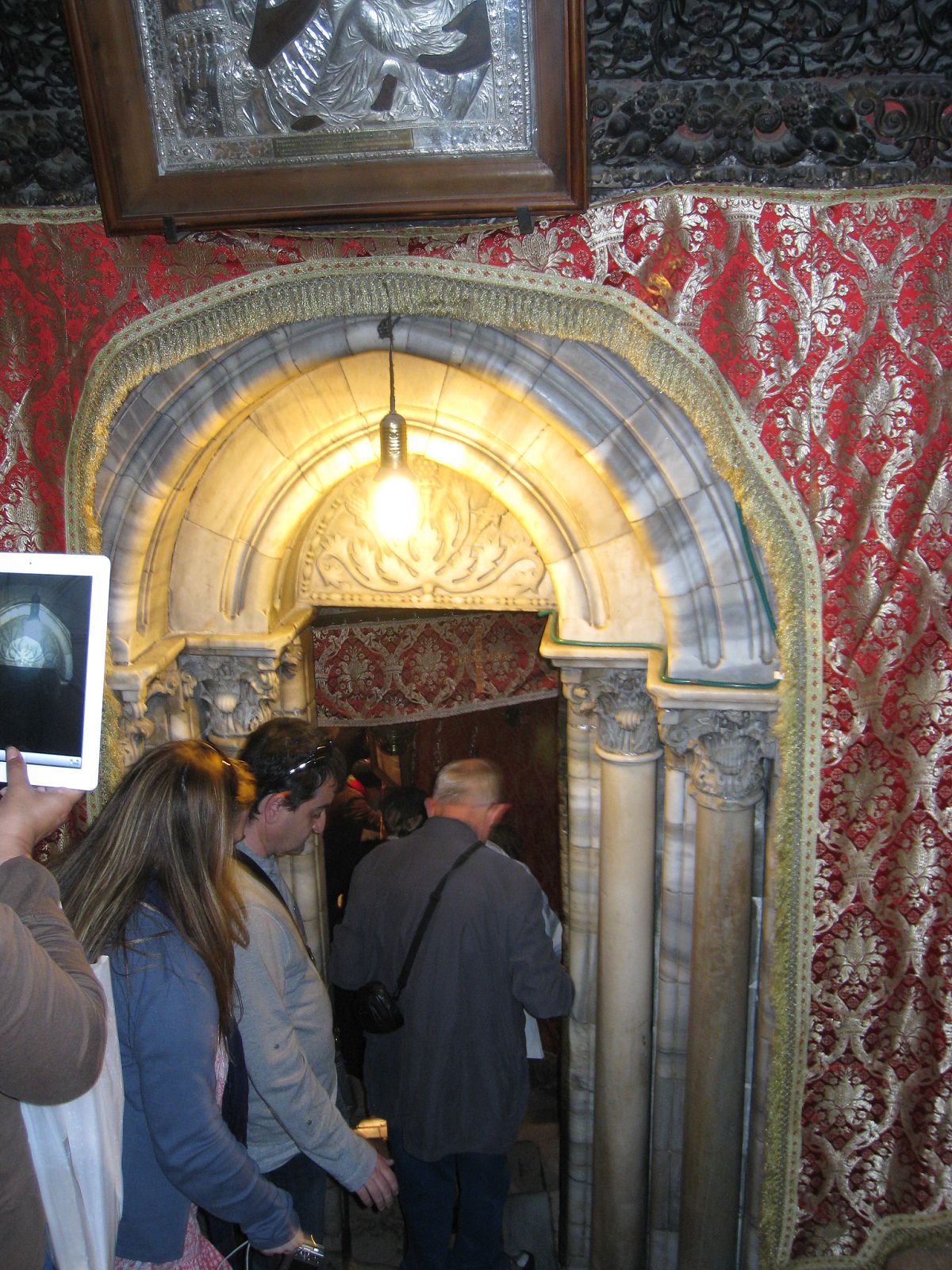
We finally make it thru the doorway, past the altar and then down the stairs to the crypt.


Here is the location of Jesus' birth.


We take a tour of the rest of the church and then proceed to the Catholic Church which is attached to this one.


The church has been decorated for a wedding that will take place that evening.

We now have to take 2 small vans to our tour bus which can't make it down these streets (ok, here's where they throw the black sack over my head - it's only paranoia if they're not really after you).

We do make it back to our tour bus and I am relieved to see Yaron. Iman does say some beautiful words to us about everyone getting along and I sure hope those words come to pass. Our adventure continues as it takes aver 40 minutes to pass through that same checkpoint we used to enter the West Back. Cars and buses are searched, passports looked at, people in private cars get out of their vehicles and it looks like they are interrogated. It's a whole different animal getting back into Israel. There is hateful graffiti on the walls which we can look at to pass the time. There are also street kids selling trinkets from the side of the road to anyone who will roll down a window for them.

I was definitely relieved when we got to the Israeli side.

You big wuss. What were you so afraid of?

Monday, June 6, 2011

Chapter 20 Sat. May 14th

I ate breakfast with Marty Cohen so that we could go to Shabbat services at the Main Schule of Jerusalem which is an Orthodox synagogue directly across the street from the hotel. As we approach the guard, he asks us if we are carrying any cell phones, which we aren't, and he allows us to enter. The lobby is magnificent with showcases of the most magnificent mezuzahs I've ever seen (except for the ones on the gates to the old city - see chapter 19). There is a large 10 ft. x 20 ft.wall with names of donors on and it requires a $1,000,000 donation to get your name on the wall. The names are about 2" high and about 1 1/2" apart. Do the math.

The service is entirely in Hebrew (go figure) with the bima in the center and women separated from the men. I am able to follow the service with some accuracy but just before we are ready to leave, I realize I'm looking at the Friday night service rather than the Saturday morning repetition of those prayers. We stayed for about 20 minutes before we had to return to the hotel to join the rest of the group.

We then walked 4 blocks to Temple Ha 'Erel which is the first Reform temple in Jerusalem. It's a very small, modest synagogue with a lady Rabbi who was very welcoming and conducted the service in both English and Hebrew. I'm not sure if that's the minhag of the temple or the English was for our benefit plus a Hillel group from Tampa and a group from Greensboro NC.

Rabbi Mark & Meryl had a torah honor.
Some of the young adults wore some really interesting tallisim. The one that caught my eye was entirely red with what looked like golden Lions of Judah on it. It looked like something out of a Harry Potter book.

There was a nice oneg afterword that was provided by TBY and the Hillel group as a donation to the temple. Everyone was very friendly and welcoming and provided a sense of community not unlike what TBY onegs are like in St. Augustine.

I'm sorry I couldn't provide any pictures of these events but clearly cameras were not appropriate for today and I didn't even need the "photography police" to tell me that.

Chapter 19 Fri eve. Western Wall, Shabbat Service at Hotel

We shower and change after a long hot day in the desert and go to the Western Wall to bring in Shabbat.

The bus brings us as close to the old city as possible and then we walk through one of the gates (I think it was the Jaffa gate). Each gate has a mezuzah affixed to it.


As the sun is setting, there are streams of people heading to the wall from all directions. We finally get to the security checkpoint which takes a while to get through.


I wasn't sure how I would react when first seeing the Western Wall but it certainly was an emotional response different than seeing any other site I've ever traveled to. The plaza is enormous with many buildings surrounding it.


I say a prayer for my dear friend Artie Heilweil and also for my cousin Michael's full recovery. The stones of the wall are surprisingly warm to the touch after the sun has beat on them all day.


The women go to the women's side of the wall. I had started to go towards that side but a woman guard stopped me and corrected my error. My bad.


We reconvene in the plaza, after spending about 30 minutes at the wall, and sing songs welcoming Shabbat.


The "song police" in the form of one of the women guards arrives and tells us to stop singing. Ronit straightens her out in a hurry by telling her that this wall belongs to everyone (or something along those lines). We keep right on singing. Many of the "Birthright" girls are dancing in a circle near their part of the wall much to the consternation of the "dance police". At the official arrival of sundown, the "photography police" arrive to tell us to stop taking pictures in a firm but not obnoxious manner and we respect his instructions - at least till we are out of the plaza and on our way back to the hotel.

Instead of eating in the main dining room, we go to the "Cow on the Roof" restaurant  (I have no idea how it got it's name) which is a private room with it's own wait staff to have a sit down Shabbat dinner instead of the buffet style dinners we have been used to. After dinner, Rabbi Mark leads us in a Shabbat Service after which, he asks each of us to describe our feelings about the trip so far. I think we were unanimous in our feelings that the trip was one of the most exciting, spiritual and enjoyable experiences of our lives. Service ended at 11:20 pm and the wait staff was exceedingly patient and made comments how interesting this was for them to experience as well. We are now officially "wiped" and ready for a good nights sleep and ready to enjoy Shabbat tomorrow.

Sunday, June 5, 2011

Chapter 18 Fri May13th Masada, Qumran and Dead Sea

We leave Jerusalem thru the Derech Har HaTsofim Tunnel and instantly go from an urban environment to rocky, rugged, desolate desert. The change in scenery is quite dramatic. 


We drive past Ma'ale Adumim which started as Jewish settlement in the West Bank and is now a city which will probably be an area fought over if Palestine is granted statehood. It rises out of the Judean desert with beautiful modern apartment complexes.


We drive for about 20 minutes looking at a moon like landscape with hills and mounds  and then drive down below sea level onto a flat plain. Near the Dead Sea, we begin to see vegetation, pomegranate orchards and huge date palm orchards.


As we approach Masada we see the spring at En Gedi which was the closest water source to the fortress 12 miles away. Two thousand years ago, the spring was located right next to the Dead Sea but is now 100's of yards away due to evaporation of water from the sea.


We take the cable car up to the top, partly because of time constraints and partly because there is no way most of us could make it up the path. All the Birthright kids march up the trail as a badge of honor.


When we get to the top but before we enter the ruins, we're standing along the rail in the upper right corner of the picture above. Marcia was adjusting her position or trying to take a picture and drops her cane over the side and it clinks and clanks down a couple of hundred feet somewhere onto the snake path (the light brown trails in the above picture). Terri Gerber volunteers to get it and Rick Palm goes to assist her and off they dash as we yell for them to be careful and not take unnecessary risks. It takes a while to locate where the cane has fallen to but they're back within 20 minutes with the cane retrieved. We all have a good laugh over that episode as we go off to tour Masada. Masada - Wikipedia, the free encyclopedia

During the tour, I read the final suicide speech given in the Synagogue by Eleazer Ben Ya'ir. The speech of Eleazar Ben Ya'ir (excerpts) - NET


Picture above is model of Herod's palace on Masada which was built as a sanctuary and place of safety for Herod in case of war.


We then travel to Qumran where the Dead Sea Scrolls were found and the museum there contains remnants of some of the scrolls. Qumran - Wikipedia, the free encyclopedia  which were written in Hebrew, Aramaic and Greek demonstrating Jewish settlements in the area for 2,000 years. Dead Sea Scrolls - Wikipedia, the free encyclopedia


We have lunch in Qumran and table conversation takes an odd twist. We discuss how to prepare broccoli by heating to at least 180F to wash out any bug parts so it does not contain any meat and is acceptable for Kashrut. I don't remember how we got on this topic but it made it into the journal.


A quick drive to one of the beaches at the Dead Sea for a quick dip. Instructions include: No splashing, don't drink water, don't get any in eyes and we were told on the previous day not to shave (men and women). I gingerly walk into the water and very quickly discover a small cut on my hand that i was unaware of. It is a much more intense sensation then you would expect with Atlantic seawater. Sensation of floating is really odd and floating on your back is preferable. floating face down is really difficult and unstable. The mud on the sea floor is supposed to have curative properties but I thought it was better suited for derm-abrasion.


The beach seems pretty popular with the locals but it is not nearly as enjoyable as a day at St. Augustine Beach. Back on the bus and back to the hotel for a quick shower before heading to the Western Wall.

Friday, June 3, 2011

Chapter 17 Thurs. May 12 Hotel check-in and night out

As usual, we arrive at the hotel in the early evening along with 2 other tour buses so the lobby is loaded with luggage, no one can get thru and people are scurrying all over the place. I am becoming quite familiar with the Israeli word "balagan" - think SNAFU. Order is finally restored and we get our bags. Ronit wants to know who wants to go Israeli dancing but Andi and I pass on that, choosing to walk around the neighborhood instead.

We start walking in the direction that the concierge told us but I did have a map in my hand which I was referring to. A nice young gentleman walks over to us and tells us that he could get us lost much better than we could ourselves. He did give us accurate directions though.

We went to the Mamilla Mall which is a very upscale shopping area, outdoor cafes and beautiful, interesting sculptures lining the outdoor walkway through the center of the mall. The walkway was strung with blue and white tiny lightbulbs which added to the festive air. It was a little disconcerting seeing so many uniformed kids, looking no older than 16,  carrying automatic weapons slung over their shoulders. I did feel safe with them around.

Terre Wallach and a few others decide to go dancing and Terre has graciously added her commentary which follows:


Ruthie, Ronit's sister who lives in the U.S., but just about commutes to Israel on a regular basis, took us to this event.  She is a spitfire who also has this infectious Israeli spirit and loves/teaches Israeli folk dancing.
The venue was a school gym in Jerusalem and the regular participants were members of a club.  As visitors, we were given the option to look on at no cost or to pay a minimum entrance fee( Can't remember the $). 
The feeling in the room reminded me of an evening of American square dancing or the Texas two-step, but the rhythms were different---- swing, waltzes, Latin beats all to soothing Israeli melody.
The leader of the event was a DJ who also served as dance instructor to the approx. 50 couples in the room.
All dancing was done in a circle--- some dances were for couples, others were for individuals. 
Each song had corresponding choreography, similar dance steps, but different routines and all participants knew what was expected.
As onlooker/participants, 5 of us (Bev, Terri & David, Bobbi and I) stood behind the circle and tried to emulate.  It wasn't easy since there were a lot of turns in choreography that moved quickly and if you got confused it was easy to bump into folks.
The Israelis were friendly and encouraged us to join them, which we did.  A few people who had been to the US engaged us in conversation.
It was a fun filled evening and Ruthie can introduce us to an Israeli Folk Dancing experience in St. Augustine/Jacksonville if we wish.


Thursday, June 2, 2011

Chapter 16 Driving to Jerusalem, 9/11 Memorial

We are finally heading to Jerusalem and we pass these really high fences that don't look like noise buffers. Ronit explains that they are 12' tall anti-sniper barricades that were erected when the Palestinians in the West Bank, which borders the highway, were shooting at the Israeli traffic. Route 443 (Israel) Not a very comforting thought but it appears there is no line of site to take pot shots at the bus (have you seen the movie "Babel"?).

We get to Jerusalem early enough to change some of our itinerary and head towards the 9/11 Memorial which was just recently dedicated. There is a 1 lane narrow road, paved thank goodness, that winds up a hillside for about 2 miles. Thankfully there are very few vehicles coming in the opposite direction.
The 9/11 Memorial is awe inspiring when we first see it and on the opposite side of a valley facing on of Jerusalem's largest cemeteries on the other.


We search for the name of Terre's daughter, Mary Jo Kimmelman, and find it.


Terre reads a poem entitled "What Is a Name?" written by Mary Jo.


We recite the Kaddish prayer. It is a very emotional moment for everyone.


We have to drive back down the road in the direction we came and as we're driving along this 1 lane country road, Ronit tells the driver to stop the bus, whispers something to him and they both run off the bus.  They proceed to quickly walk along the side of the road stopping at each tree and picking something off the tree. After they've loaded their pockets, they get back on the bus and start handing out unripe almonds.


We tear off the fuzzy green coating to get to the nut's shell and then break that open so we can eat the nut which tastes sort of like a barely ripe green bean. It's very soft and doesn't taste anything like an almond.

The bus continues down the road, gets back on the highway and then continues to Mt. Scopus where we recite the Barucha over wine and sip from olive wood kiddush cups that the bus driver brought with him. If you look closely at the picture, you can see the small cups we're holding.


We then watch the sun set over Jerusalem before heading to the hotel.